Football Injury Prevention
The role of the coach, the fitness coach, the doctor, the physiotherapist and the board in preventing or reducing injuries: evidence-based programmes, calculated training load, readiness for emergencies, and a safe return for the injured player.
This course is taught in Arabic: the videos, the texts and the quizzes are in Arabic.
9 units10 hours (approx.)130 quiz questions$49 · 184 SAR PriceCertificate with a verification number
The nine units
Every unit has a video, the full text built on studies, a ready-to-use practical tool, a case study to discuss, a worksheet and a ten-question quiz. Throughout the course we follow the injuries of the virtual Al-Rafidain Club and build its prevention plan step by step.
- 55 min · free
The map of football injuries
The most common football injuries, where and when they happen, how many injuries a team can expect in a season, how to record injuries and calculate their rate and burden, and the four-step prevention sequence.
- 60 min
The prevention team: roles and responsibilities
The roles of the coach, the fitness coach, the doctor, the physiotherapist, the board and the player himself, who decides whether an injured player plays, and how the team communicates every day so that nothing gets lost between the pitch and the clinic.
- 65 min
The preventive warm-up: the FIFA 11+
The warm-up programme that cut injuries by about a third in studies, with its three parts, fifteen exercises and levels, and the real secret of its success: doing it at least twice a week.
- 70 min
Managing training load and fatigue
How to measure training load with perceived exertion and minutes, why sudden spikes cause injuries, the two-match week, returning after a break, and young players and rapid growth.
- 75 min
Muscles and joints: thigh, groin, ankle and knee
Preventing hamstring injuries with the Nordic exercise, groin injuries with the Copenhagen exercise, ankle sprains with balance work and ACL injuries with neuromuscular control, and how to fit them into the week.
- 70 min
Concussion and emergencies on the pitch
Recognising concussion and the rule “if in doubt, sit them out”, the red flags that call for an ambulance, cardiac arrest and the defibrillator, and a written emergency plan that the whole staff practises.
- 60 min
Sleep, nutrition, recovery and heat
Sleep as a preventive weapon, nutrition and fluids after effort, recovery between matches, and playing in the Iraqi summer heat: the heat index, cooling breaks and the signs of heatstroke.
- 65 min
A safe return to play
Returning in stages — participation, then play, then full performance — by criteria and not by days alone, the shared decision between doctor, physiotherapist, coach and player, and preventing re-injury.
- 70 min
The board’s role and the club’s prevention plan
What the board funds and organises: medical staff, pre-season screening, the defibrillator, insurance, the pitch, the fixture list, the log and the club culture, then bringing everything you learned together in a complete prevention plan.
- about two hours
Graduation project
“The club’s prevention plan”: ten parts, from the injury log, roles, warm-up and load to emergencies, the return to play and the board’s role, assessed by the smart tutor. The pass mark is 60.
- 60 min
Final exam
Forty questions, ten of them on two practical cases from the pitch. Get twenty-eight right and your certificate is issued.
Who this course is for
- Coaches of football and their assistants, and academy and youth-age coaches.
- Fitness staff, physiotherapists and injury specialists.
- Team doctors, team managers and board members responsible for the medical side.
- No medical specialism is needed: the course explains in clear language and sets out what stays with the doctor and the physiotherapist.
What you get
- 9 Videos that explain each unit with examples from the pitch.
- Ready-made tools: the injury log, the roles matrix, the 11+ card, the load calculator, the emergency plan, the concussion card and the return stages.
- A smart tutor that helps you design your team’s programmes, answers your questions, and refers you to a doctor when needed.
- A case study and a worksheet in every unit, and a graduation project with detailed feedback.
- A certificate of completion with a verification number issued when you pass the project and the final exam.
Your certificate when you pass
Pass the graduation project and the final exam, and your certificate is issued at once in your name, ready to print or save as a PDF.
- A certificate of completion in English in A4 size.
- A verification number of its own, and a QR code that opens the verification page on eiast.se.
- Your study hours, your graduation project mark and your final exam result.
- It stays valid and any organisation can verify it at any time. It is a certificate of completion from the academy; it does not qualify you to practise medicine or physiotherapy, and it does not replace a certified first aid and CPR course.
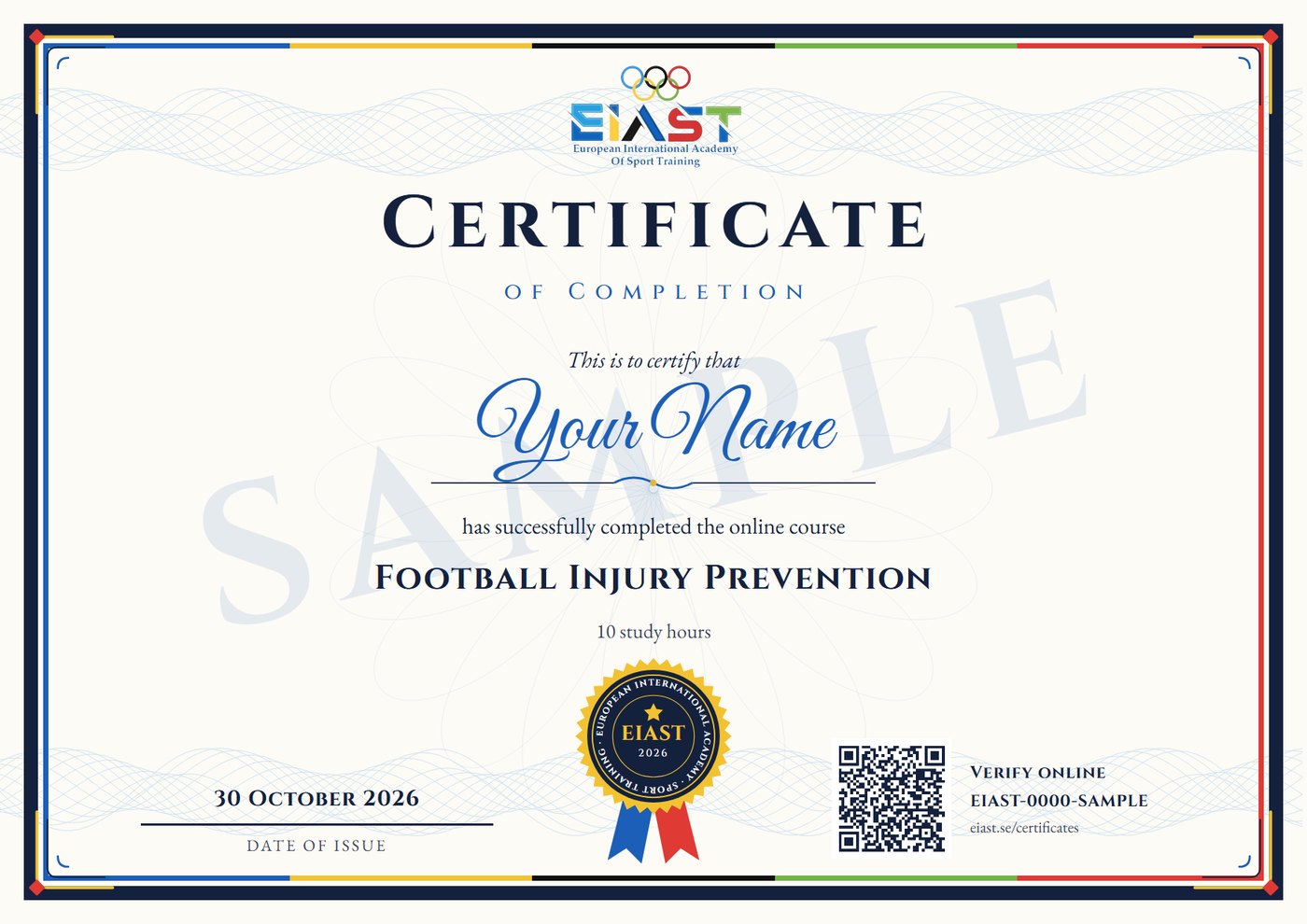 View the sample at full size
Start the course today
Buy the course once and unit one opens. Each unit opens the next, then the graduation project and the final exam, and your certificate is issued as soon as you pass.