Goalkeeper Coach
Preparation
The goalkeeper is the player who most needs specific coaching and the one who gets the least. This course prepares you to coach him properly: what to coach, from stance, handling and diving to one-on-ones, crosses and distribution; how to coach, through planning, progression, observation and the right intervention; and whom you coach, from the professional goalkeeper to the young player and the girl, body and mind. It is built on the Asian Football Confederation’s Level 1 goalkeeper coaching curriculum and updated with research in motor learning, sports science and the current Laws of the Game.
This course is taught in Arabic: the videos, the texts and the quizzes are in Arabic.
14 units in 4 modules22 hours (approx.)180 quiz questions$89 · 334 SAR PriceCertificate with a verification number
The four modules and the fourteen units
Every unit has a video, the full text with tables, diagrams and pictures, a practical tool you apply with your goalkeepers, a case study to discuss, a worksheet and a ten-question quiz. Throughout the course we follow Ali, a new goalkeeper coach at a professional club; Maryam, a physical education teacher who coaches two female goalkeepers; and Samer, the director of a youth academy.
Module 1: The goalkeeper coach and the coaching method
- 69 min · free
The modern goalkeeper and his coach: the role, the qualities and the relationship with the coaching staff
How the goalkeeper’s position has changed, the goalkeeper coach’s five areas of work — technical, tactical, physical and psychological development, match preparation, and talent identification — the qualities of a good coach, and his relationship with the head coach, the fitness coach and the physiotherapist.
- 74 min
How a goalkeeper learns: coaching methods and the right intervention
The stages of learning a skill, command style, question and answer and guided discovery, the steps of intervention — stop, explain, demonstrate and repeat — feedback, isolated practice versus game-related practice, and the constraints-led approach.
- 74 min
Planning, organising and evaluating a goalkeeper session
Purpose, objective, priorities and organisation, the twenty questions before a session, building a session from the specific warm-up to application and then the cool-down, progression within a drill, the work-to-rest ratio, and evaluating the session afterwards.
Module 2: Technical fundamentals
- 74 min
The set position, positioning and footwork
The set position and its timing with the moment of the shot, the angle line and the positioning arc, the goalkeeper’s depth from the goal, the side step, the cross-over step and running backwards, and speed and agility drills for the feet.
- 74 min
Handling shots from the front: ground, mid-height and high balls
The principle of getting to the line of the ball, ground handling by bending and the kneeling position, mid-height balls into the stomach, high balls with the W shape, soft hands and a strong wrist, common mistakes and correcting them, and progressing the drill from a still ball to the half-volley.
- 79 min
Collapsing and diving: close, far and high balls
The collapse dive for close balls, low and mid-height dives, flying for high balls, stepping towards the line of the ball, one hand behind the ball and one on top, landing safely, and teaching the dive from sitting to kneeling to standing.
- 69 min
Parrying, deflecting and clearing: when to catch and when to steer the ball away
The decision to catch or deflect, steering the ball into safe zones outside the posts, parrying with a firm palm, rebounds, following the ball and covering the goal, and getting up quickly for the second ball.
Module 3: Game situations, distribution and the team
- 79 min
Facing the striker: one against one
The goalkeeper’s priorities: protect the goal, then the space behind the defenders; the decision to come out or wait, timing with the striker’s touch, blocking with the body and the feet and smothering the ball, patience and making the striker decide, and safety and courage.
- 79 min
Dealing with crosses and set pieces
Stance and positioning according to where the cross comes from, reading the flight of the ball, the decision to come or stay, clear calls to defenders, taking off from the inside foot, catching at the highest safe point, punching with one or two hands, the near and far post, and corners, walls and penalties.
- 79 min
Distributing the ball and starting the attack: with the hands and the feet
Rolling, the javelin throw, the side-arm throw and the overarm throw; goal kicks, volleys, half-volleys and side volleys; the back pass and playing with the feet, building from the back and the sweeper-keeper; and when to pass to feet and when into space.
- 69 min
The goalkeeper in the team: communication and organising the defence
The goalkeeper as an individual and as a team player, his role in the three phases — when the opponent has the ball, in transition and when his team has it — precise, clear, short calls, organising the defensive line and the wall, and the sweeper-keeper behind the defence.
Module 4: Body, mind, development and assessment
- 74 min
Goalkeeper-specific physical preparation and injury prevention
The goalkeeper’s physical match demands: short explosive efforts and long rest, strength, power, speed, reaction, agility and flexibility, the specific warm-up, injuries to the fingers, shoulder, hip and head, working with the fitness coach and the physiotherapist, and monitoring growth.
- 74 min
The mind in goal, and developing young and female goalkeepers
The six psychological factors — confidence, focus, calm, commitment, mental courage and physical courage — dealing with mistakes and criticism, mental imagery, the stages of developing a young goalkeeper, coaching girls, and talent identification with its assessment form.
- 79 min
Match preparation, performance analysis, practical assessment and the graduation project
The goalkeepers’ weekly plan, the match-day warm-up for two goalkeepers together, post-match analysis with video and numbers, the practical assessment form with its twelve criteria, how to deliver a twenty-minute assessed session, then an explanation of the graduation project.
- 4 hours (approx.)
Graduation project
“The goalkeeper coach’s portfolio”: two assessed twenty-minute sessions, one technical and one applied, modelled on the practical assessment in federation courses, with a goalkeeper profile, a match-week plan and a self-assessment against the twelve criteria, in eight parts. Assessed by the smart tutor; the pass mark is 60.
- 60 min
Final exam
Forty questions from the four modules. Get twenty-eight right and your certificate is issued.
Who this course is for
- Football coaches who want to specialise in coaching goalkeepers.
- Former and current goalkeepers who are preparing to start coaching.
- Academy and youth-age coaches, and anyone who coaches goalkeepers at small clubs.
- Physical education teachers who coach school teams.
What you get
- 14 videos that explain each unit with pictures and diagrams.
- Ready-made tools: a session plan template, a coaching intervention template, a stance observation card, a diving progression ladder, a safe-zones map, a one-on-one decision tree, a crosses card, a distribution log, a calls dictionary, a goalkeeper’s physical week and a practical assessment form.
- A project of two assessed sessions, assessed by the smart tutor.
- A smart tutor that answers from the unit’s text.
- A certificate of completion with a verification number. All you need is balls, cones and a goal, ideally with a goalkeeper to practise with.
Your certificate when you pass
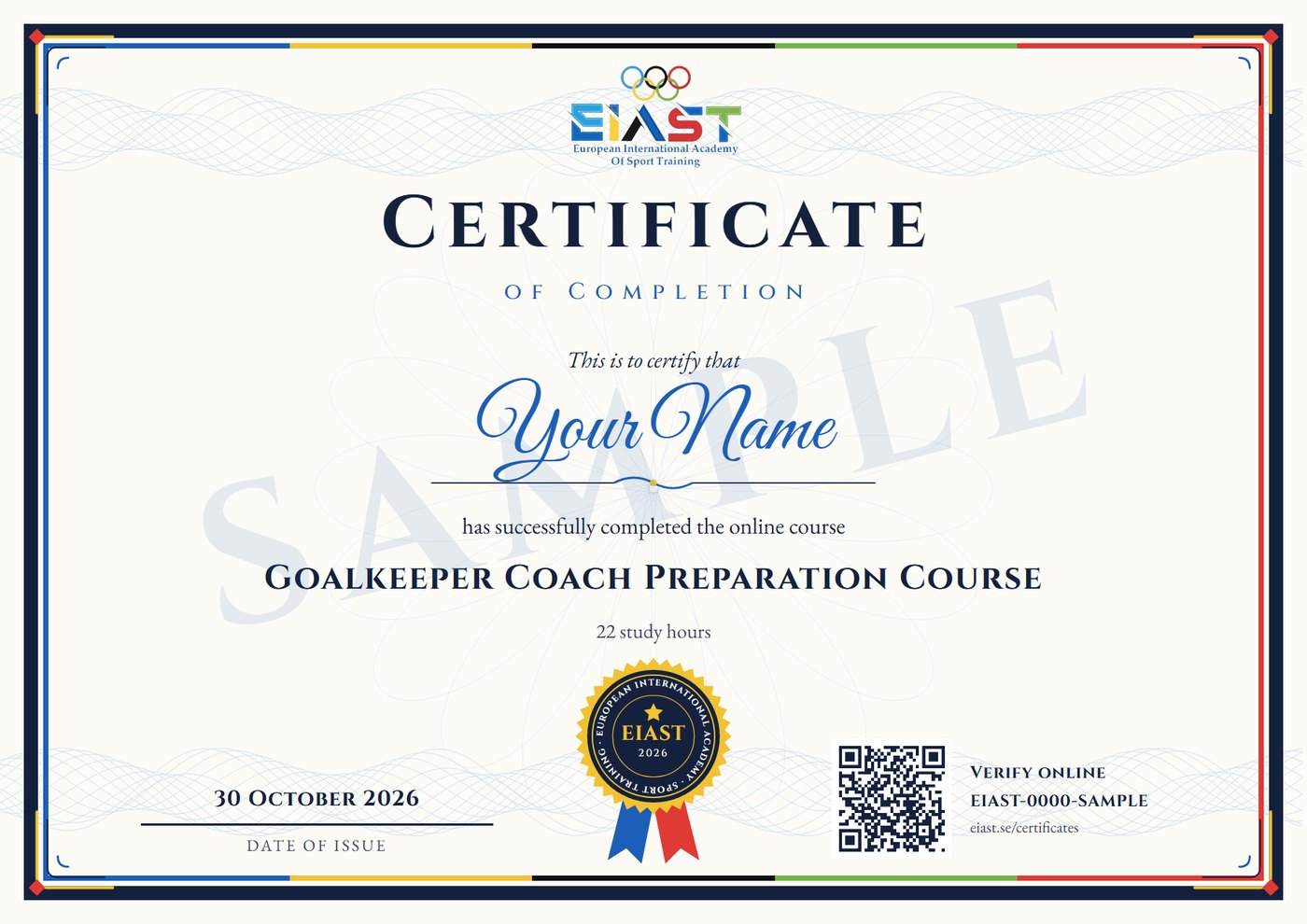
Pass the graduation project and the final exam, and your certificate is issued at once in your name, ready to print or save as a PDF.
- A certificate of completion in English in A4 size.
- A verification number of its own, and a QR code that opens the verification page on eiast.se.
- Your study hours, your graduation project mark and your final exam result.
- It stays valid and any organisation can verify it at any time. It is a certificate of completion from the academy, not a coaching licence from a football association.
 View the sample at full size
Start the course today
Buy the course once and unit one opens. Each unit opens the next, then the graduation project and the final exam, and your certificate is issued as soon as you pass.