Mental Health
and Stress Management
A course for everyone who works with people and everyone who wants to understand themselves: you understand stress in the body and the mind, recognise the signs of anxiety, depression and burnout, learn proven tools for breathing, thoughts, mindfulness and sleep, support athletes, staff and teenagers, give psychological first aid, and know when and how to refer.
This course is taught in Arabic: the videos, the texts and the quizzes are in Arabic.
14 units in 4 modules22 hours (approx.)180 quiz questions$69 · 259 SAR PriceCertificate with a verification number
The four modules and the fourteen units
Every unit has a video, the full text with tables, diagrams and pictures, a ready-to-use practical tool, a case study to discuss, a worksheet and a ten-question quiz. Throughout the course we follow Layla at Al-Waha Club and her “Safe Space” programme: Samer, worn out by work; Nour, a basketball player anxious before matches; Umm Ahmed, after losing her husband; and Yasser, after his injury.
Module 1: Understanding mental health and stress
- 62 min · free
Mental health: the concept, the spectrum, stigma and your role
What mental health is, the spectrum between flourishing and illness, how common disorders are, stigma in our communities and how to break it, and the role of the coach, the teacher and the leader and its limits.
- 72 min
Stress: how it works in the body and the mind
The fight-or-flight response, cortisol and the stress axis, helpful and harmful stress, the performance curve, chronic stress and its load on the body, and appraising the situation and your coping resources.
- 77 min
Anxiety, depression and burnout: the signs and when to worry
The difference between normal worry and an anxiety disorder, sadness and depression, panic attacks, burnout, short screening tools, and red flags and when to refer.
Module 2: Coping tools
- 61 min
Breathing and relaxation: calming the body first
Slow breathing with a long out-breath, the physiological sigh, box breathing, progressive muscle relaxation, the five-senses exercise, and when to use each tool.
- 82 min
Thoughts and feelings: tools from cognitive behavioural therapy
The triangle of situation, thought, feeling and behaviour, common thinking errors, the thought record, looking for evidence, behavioural activation, and facing avoidance step by step.
- 67 min
Mindfulness, acceptance and values
What mindfulness is and is not, the scientific evidence, short daily exercises, acceptance instead of struggling with feelings, defusing from thoughts, and living by your values.
- 77 min
Sleep, movement and food: the foundation of mental health
Sleep, how much we need and healthy sleep habits, insomnia and what helps, physical activity as a medicine for mood and anxiety, food and mood, and caffeine, screens and smoking.
- 66 min
Time, boundaries, problem-solving and relationships
Step-by-step problem-solving, managing time and priorities, setting boundaries and saying “no” respectfully, social support, assertive communication, and the digital world.
Module 3: At work, in sport and in crises
- 71 min
Work stress and burnout
What burnout is, the job demands-resources model, burnout among coaches, teachers and health workers, prevention for the individual and the organisation, and returning after leave.
- 77 min
Athletes and mental health: performance, injury and retirement
How common symptoms are among athletes, performance pressure and pre-competition anxiety, injury and return, eating disorders, retirement, and the coach’s role in a safe culture.
- 77 min
Loss, trauma and crises
Normal grief and its flexible stages, prolonged grief, reactions after trauma, the natural resilience of most people, and psychological first aid: look, listen and link.
Module 4: Helping and resilience
- 72 min
Children and teenagers: stress, bullying and screens
When disorders begin, signs of distress in children and teenagers, the pressure of school and exams, bullying, social media, and the role of parents, the school and the club.
- 82 min
Psychological first aid: how to help and refer
The steps of helping: approaching and asking, listening without judgement, information and support, encouraging professional help, and dealing with suicidal thoughts through direct questions, safety and emergency services.
- 72 min
Resilience, self-care and the graduation project
What resilience is and how it is built, a self-care plan for the facilitator, meaning in life, gratitude and spirituality, preventing helper fatigue, then an explanation of the graduation project.
- 4 hours (approx.)
Graduation project
“A stress management and mental health programme for a group”: six weeks for a sports team, staff, students or coaches, in eight parts, from understanding the group and measuring to detailed sessions, lifestyle, support, referral and emergencies. Assessed by the smart tutor; the pass mark is 60.
- 60 min
Final exam
Forty questions from the four modules. Get twenty-eight right and your certificate is issued.
Who this course is for
- Sports coaches and fitness coaches who see their players every week.
- Teachers and counsellors and student activity coordinators.
- Leaders and managers and human resources staff at clubs and organisations.
- Anyone who wants to understand their own stress and support their family and friends.
What you get
- 14 videos that explain each unit with pictures and diagrams.
- Ready-made tools: a stress diary, a calming exercises card, a thought record, a lifestyle plan, a problem-solving plan, and a help and referral plan.
- Cards for red flags, the steps of psychological first aid, and suicidal thoughts.
- A smart tutor that answers from the unit’s text.
- A certificate of completion with a verification number issued when you pass the project and the final exam.
Your certificate when you pass
Pass the graduation project and the final exam, and your certificate is issued at once in your name, ready to print or save as a PDF.
- A certificate of completion in English in A4 size.
- A verification number of its own, and a QR code that opens the verification page on eiast.se.
- Your study hours, your graduation project mark and your final exam result.
- It stays valid and any organisation can verify it at any time. It is a certificate of completion from the academy, not a licence to practise psychotherapy or clinical counselling.
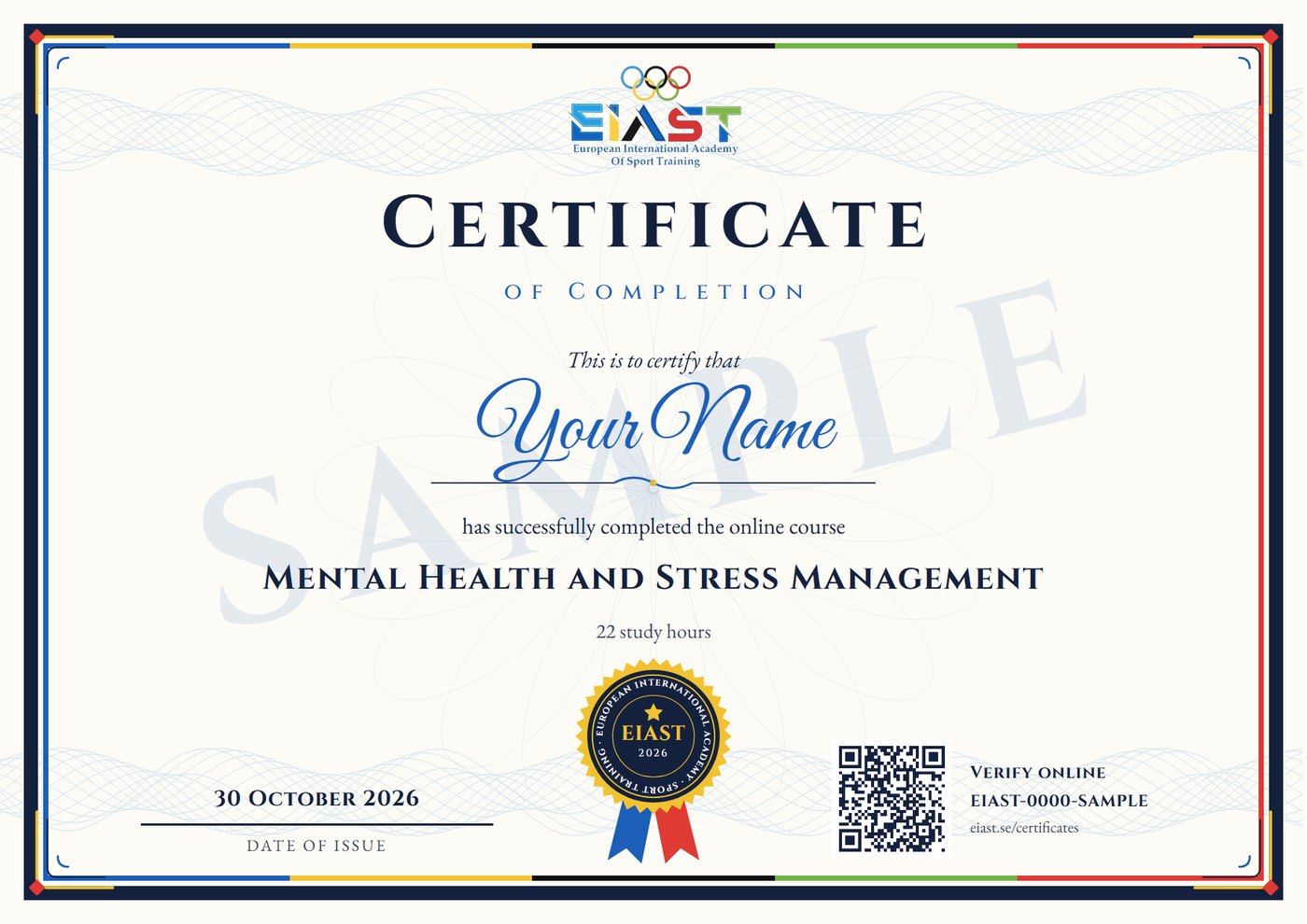 View the sample at full size
Start the course today
Buy the course once and unit one opens. Each unit opens the next, then the graduation project and the final exam, and your certificate is issued as soon as you pass.