Pilates Instructor Training
Level 1: Mat Pilates Fundamentals
A course that trains a Pilates instructor from the ground up: why Pilates works, how the core, the spine and the pelvis move, and how to teach breathing and alignment, then the preparatory exercises and the classical mat exercises by name, with three versions of each exercise. You design a 30- to 45-minute class and an eight-week programme, run a group class with clear cues, and know when to modify and when to refer.
This course is taught in Arabic: the videos, the texts and the quizzes are in Arabic.
14 units in 4 modules22 hours (approx.)180 quiz questions$69 · 259 SAR PriceCertificate with a verification number
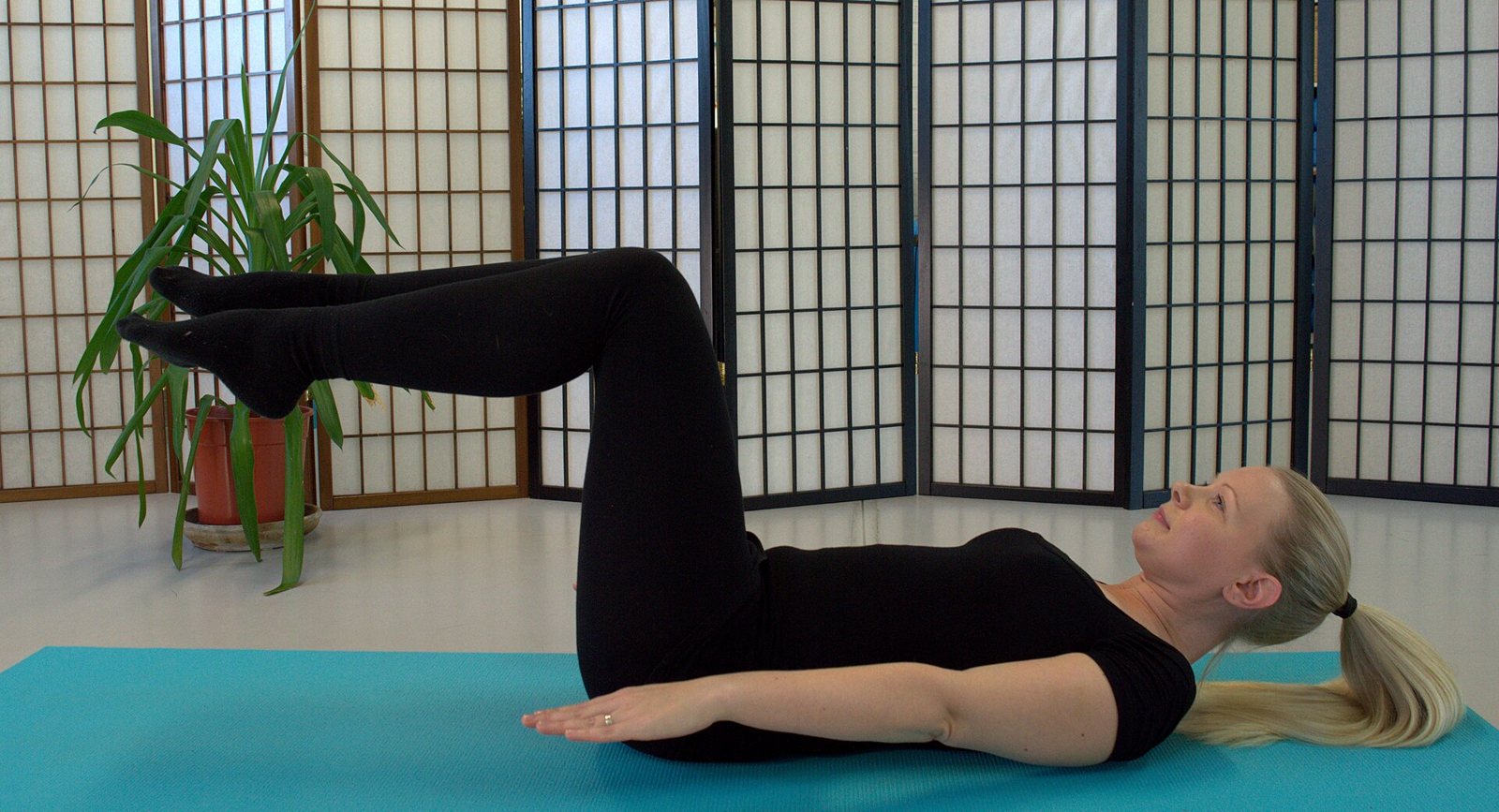
The four modules and the fourteen units
Every unit has a video, the full text with tables, pictures and diagrams, exercise cards with their aims, cues, mistakes and modifications, a ready-to-use practical tool, a case study to discuss, a worksheet and a ten-question quiz. Throughout the course we follow Layla, a trainee instructor, and her three clients: Mona, whose back hurts from sitting; Omar, a runner; and Huda, who has weak bones.
Module 1: Pilates and its principles
- 61 min · free
Pilates: its history, its types and the instructor’s profession
The story of Joseph Pilates and “Contrology”, classical, contemporary and clinical Pilates, mat and apparatus Pilates, and who the Pilates instructor is and the limits of the role.
- 66 min
The six principles: concentration, control, centring, precision, breath and flow
The principles that make a movement Pilates rather than just an ab exercise, how they show in every repetition, and the alignment principle that modern schools added.
- 61 min
Pilates, yoga and weight training: differences and how they complement each other
How Pilates, yoga and resistance training differ in origin, aim and method, what the scientific evidence says about the benefits of Pilates, and how each complements the others.
Module 2: The body in Pilates
- 77 min
Anatomy of the core: the deep abdominals, the diaphragm, the pelvic floor and the back
“cylinder” that stabilises the trunk: the transversus abdominis, the obliques and the rectus abdominis, the multifidus and the erector spinae, the diaphragm and the pelvic floor, and the hip muscles.
- 71 min
The spine, the pelvis and the shoulder: alignment and neutral
The natural curves of the spine, neutral and imprinted pelvis, spinal movements, scapular stability, the head and neck, and how to teach alignment.
- 62 min
Breathing in Pilates and trunk control
Lateral thoracic breathing, the relationship between the diaphragm, the pelvic floor and the deep abdominals, breathing with movement, and when to adjust the breathing.
- 72 min
Posture and movement: assessing the body before training
Observing posture from the front, the side and the back, common patterns, simple movement tests, and what Pilates can and cannot improve.
Module 3: The exercises
- 77 min
Preparatory exercises: mat fundamentals
The exercises every beginner starts with: the pelvic clock, imprinting, the head nod, the knee fold, the bridge, scapular isolation, cat-cow and the side-lying exercises.
- 82 min
Classical mat exercises (1): the hundred, rolling and circles
The hundred, the roll-up, the single-leg circle, rolling like a ball, the single- and double-leg stretch, and the spine stretch forward: aim, execution, cues, mistakes and modifications.
- 82 min
Classical mat exercises (2): stability, balance and extension
The saw, the swan, the single-leg kick, the side-kick series, the shoulder bridge, swimming, the front and side plank, the mermaid, and preparing for the teaser.
- 72 min
Progressions, modifications, small props and equipment
How to make an exercise easier or harder, the ball, the ring, the band and the roller, and a look at the reformer, the Cadillac, the chair and the barrel and their safety.
Module 4: Teaching and safety
- 77 min
Designing a Pilates class and a training programme
The structure of a 30- to 45-minute class, choosing and ordering exercises, the balance between flexion, extension, rotation and side-bending, an eight-week programme, and classes for different groups.
- 77 min
The art of teaching: cues, corrections and running a group class
Verbal, visual and tactile cues, imagery, counting and rhythm, correcting one mistake at a time, modifications for beginners, and managing a group with different levels.
- 77 min
Safety, health screening and the graduation project
Screening before starting, conditions that need modification or a medical opinion (pregnancy, osteoporosis, disc problems, abdominal separation, high blood pressure), signs of exercise intolerance, equipment safety, then an explanation of the graduation project.
- 4 hours (approx.)
Graduation project
“An eight-week mat Pilates programme”: eight parts, from screening, assessment and goals to three complete written classes, modifications and progressions, cues and corrections, a client who needs adjustments, and safety. Assessed by the smart tutor; the pass mark is 60.
- 60 min
Final exam
Forty questions from the four modules. Get twenty-eight right and your certificate is issued.
Who this course is for
- Anyone who wants to become a Pilates instructor on the mat.
- Fitness and gym coaches who want to add Pilates to their classes.
- Coaches at women’s clubs and health care centres.
- Physical education teachers, and advanced Pilates practitioners.
What you get
- 14 videos that explain each unit with pictures and diagrams.
- Cards for more than 30 exercises, preparatory and classical, with aims, breathing, cues, mistakes and three versions of each exercise.
- Ready-made tools: a posture and movement assessment card, a progression ladder, a 45-minute class template, a bank of verbal cues, and a safety checklist.
- A smart tutor that answers from the unit’s text and helps you design your classes.
- A certificate of completion with a verification number issued when you pass the project and the final exam.
Your certificate when you pass
Pass the graduation project and the final exam, and your certificate is issued at once in your name, ready to print or save as a PDF.
- A certificate of completion in English in A4 size.
- A verification number of its own, and a QR code that opens the verification page on eiast.se.
- Your study hours, your graduation project mark and your final exam result.
- It stays valid and any organisation can verify it at any time. It is a certificate of completion from the academy, not an external professional licence or a physiotherapy qualification.
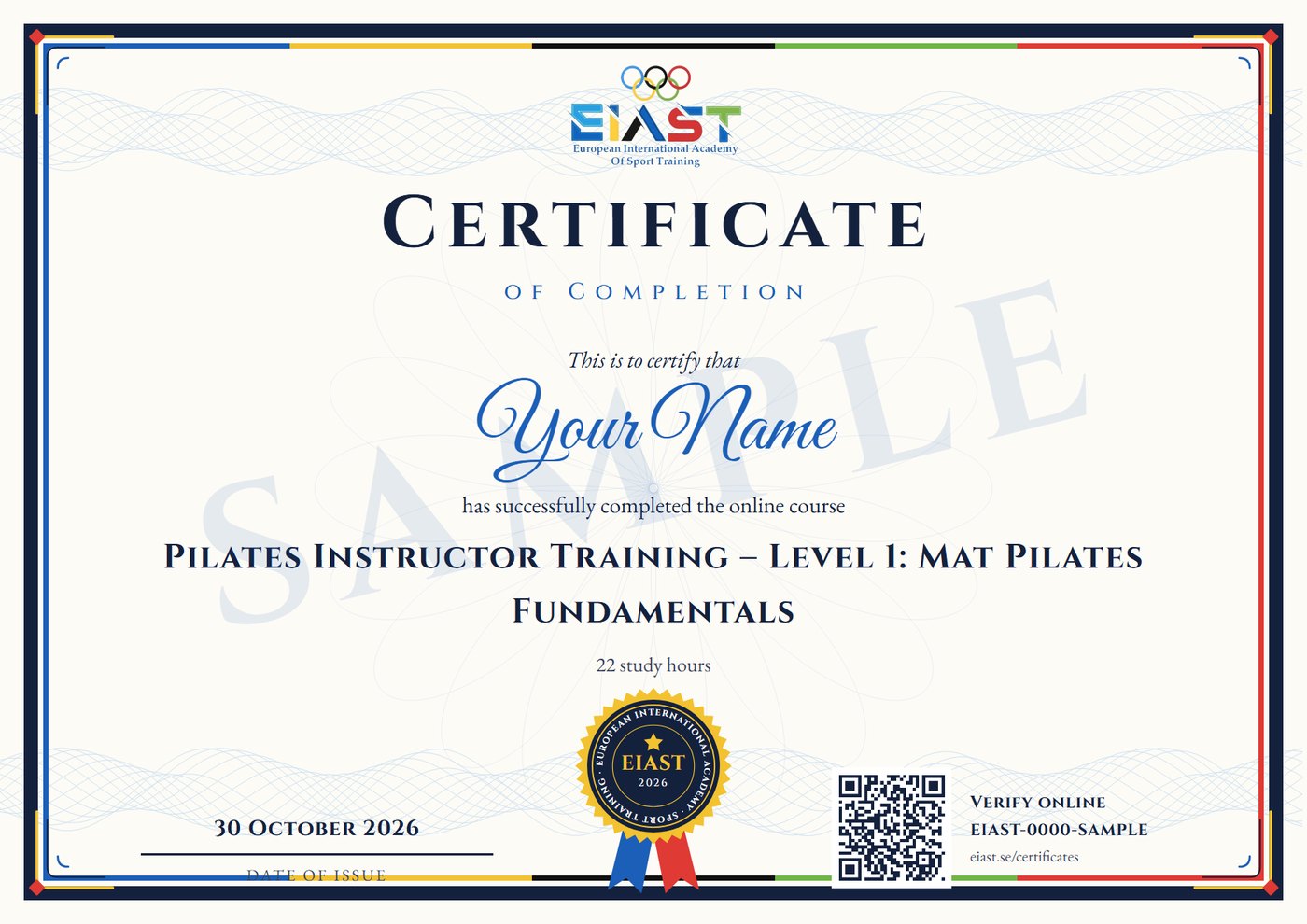 View the sample at full size
Start the course today
Buy the course once and unit one opens. Each unit opens the next, then the graduation project and the final exam, and your certificate is issued as soon as you pass.