The Art of Public Speaking
For anyone who stands in front of an audience: in a work meeting, a classroom, a community gathering or before a team ahead of a match. Control your nerves, speak with a clear voice and confident body language, build your speech from idea to close, persuade with story, example and number, and answer hard questions calmly.
This course is taught in Arabic: the videos, the texts and the quizzes are in Arabic.
10 units17 hours (approx.)140 quiz questions$59 · 221 SAR PriceCertificate with a verification number

The ten units
Every unit has a video, the full text with examples and diagrams, a practical tool you apply to your own speech, a case study for discussion, a worksheet and a ten-question quiz. We follow four speakers: Layla, a teacher at her first conference; Khaled, between the pitch and the office meeting; Sara, defending her graduation project; and Mohannad, persuading the council to back a children’s league.
Module 1: The speaker, confidence and tools
- 65 min · free
Why learn public speaking? The effective speaker, from the pitch to the podium
What public speaking is and why it is a learnable skill, not an inborn gift; speaking situations in the life of an employee, a student, a coach and a team captain; the five elements of the speaking situation: speaker, message, audience, channel and context; ethics: honesty and respect for the listener and their time; then assessing your starting point.
- 70 min
Stage fright: understand anxiety and turn it into energy
Why most people fear speaking in public, what happens in body and mind, the three thinking traps, reframing nerves as excitement, slow breathing, graded exposure, reassuring preparation, and a pre-speech routine like an athlete’s before a match.
- 70 min
The voice as the speaker’s tool: breathing, tone, pace and pauses
Breathing from the diaphragm, volume and projecting your voice across the room, the right pace in words per minute, the pause before and after the key idea, intonation and emphasis, clear articulation, filler words such as "like" and "um", and caring for your voice.
- 70 min
Body language: stance, movement, gestures and eye contact
A steady, balanced stance, purposeful movement on stage, open gestures that explain, facial expression and the smile, eye contact with the zone method, dress that suits the occasion, correcting the "93% of communication is non-verbal" myth, and keeping body and words in agreement.
Module 2: The speech, from idea to stage
- 65 min
Know your audience, set your goal: audience analysis and the single message
Who is sitting in front of you: age, background, prior knowledge and attitude to the topic; what each audience needs; the general purpose (to inform, persuade, motivate or mark an occasion) and the specific purpose; the key message in one sentence; and choosing content, level and examples for the audience.
- 75 min
Building the speech: a strong opening, an organised body and a memorable close
Seven ways to open and grab attention, organising the body into three points by time, space, problem–solution and cause–effect, transitions between ideas, a close that sums up and calls to action, timing, and turning a written text into points you speak from.
- 75 min
Story, example and number: tools of persuasion and influence
The three pillars of persuasion: credibility, emotion and logic; building a short story from situation to challenge to turning point to lesson; examples, comparisons and analogies; presenting numbers people understand; quotations; honest persuasion versus manipulation; and the pre-match motivational talk as a model.
- 65 min
Slides, notes and the room: visual aids and preparation
When slides help and when they hurt, one idea per slide, a picture instead of a paragraph, font size and contrast, notes on cards, rehearsing out loud, recording yourself on video, checking the room, microphone and technology, and the backup plan for when something fails.
Module 3: Special situations and growth
- 75 min
Special situations: impromptu speaking, hard questions, press conferences and speaking online
Speaking without preparation with the Point–Reason–Example–Point template, running Q&A, the hostile question and the one you cannot answer, the post-match press conference, short speeches for occasions, and speaking on camera and in online meetings.
- 70 min
Practice, evaluation and a development plan, and the final speech project
How to practise smartly, feedback from others and from your own recording, the ten-criteria evaluation form, speaking clubs and practice opportunities in your community, a three-month development plan, then the final speech project explained part by part.
- 4 hours
Graduation project
“My Speech": a five-minute speech you give on video or to a real audience, with seven written parts, from audience analysis, the message and the speech outline, through story, example and number, to the delivery plan, self-evaluation against the ten criteria and a development plan.
- 60 min
Final exam
Forty questions from the three modules. Pass with twenty-eight and your certificate is issued.
From the Community Development section
This is the first course in the Community Development Courses. Open to everyone, no sports background needed. Sport is the example and the training ground: the captain’s talk before the match, the press conference after it, and the meeting with players’ parents.
For the employee, the student and the teacher
Presenting a report in a meeting, the job interview, defending a graduation project, explaining in class, and meeting parents.
For the coach and the initiative leader
The motivational talk, the media interview, persuading sponsors and the council, recruiting volunteers, and speeches for occasions.
Who this course is for
- Employees who present ideas and reports in meetings.
- Students before class presentations and graduation project defences.
- Teachers, coaches and team leaders.
- Initiative leaders and volunteers, and anyone who wants to speak with confidence.
What you get
- 10 videos presented by Salma, explaining each unit with examples and diagrams.
- Ready-made tools: the ten-minute pre-speech routine, the daily voice workout, the body-language observation card, the audience and message template, the three-part speech template, the story bank, the pre-speech checklist, the hard-question cards, and the ten-criteria evaluation form.
- A real speech project assessed by the smart tutor.
- A smart tutor that answers from the unit text and helps with your next speech.
- A certificate of completion with a verification number. All you need is a phone that records video and one or two people to listen to you.
Your certificate when you pass
Pass the graduation project and the final exam, and your certificate is issued at once in your name, ready to print or save as a PDF.
- A certificate of completion in English in A4 size.
- A verification number of its own, and a QR code that opens the verification page on eiast.se.
- Your study hours, your graduation project mark and your final exam result.
- It stays valid and any organisation can verify it at any time. It is a certificate of completion from the academy, not a university degree.
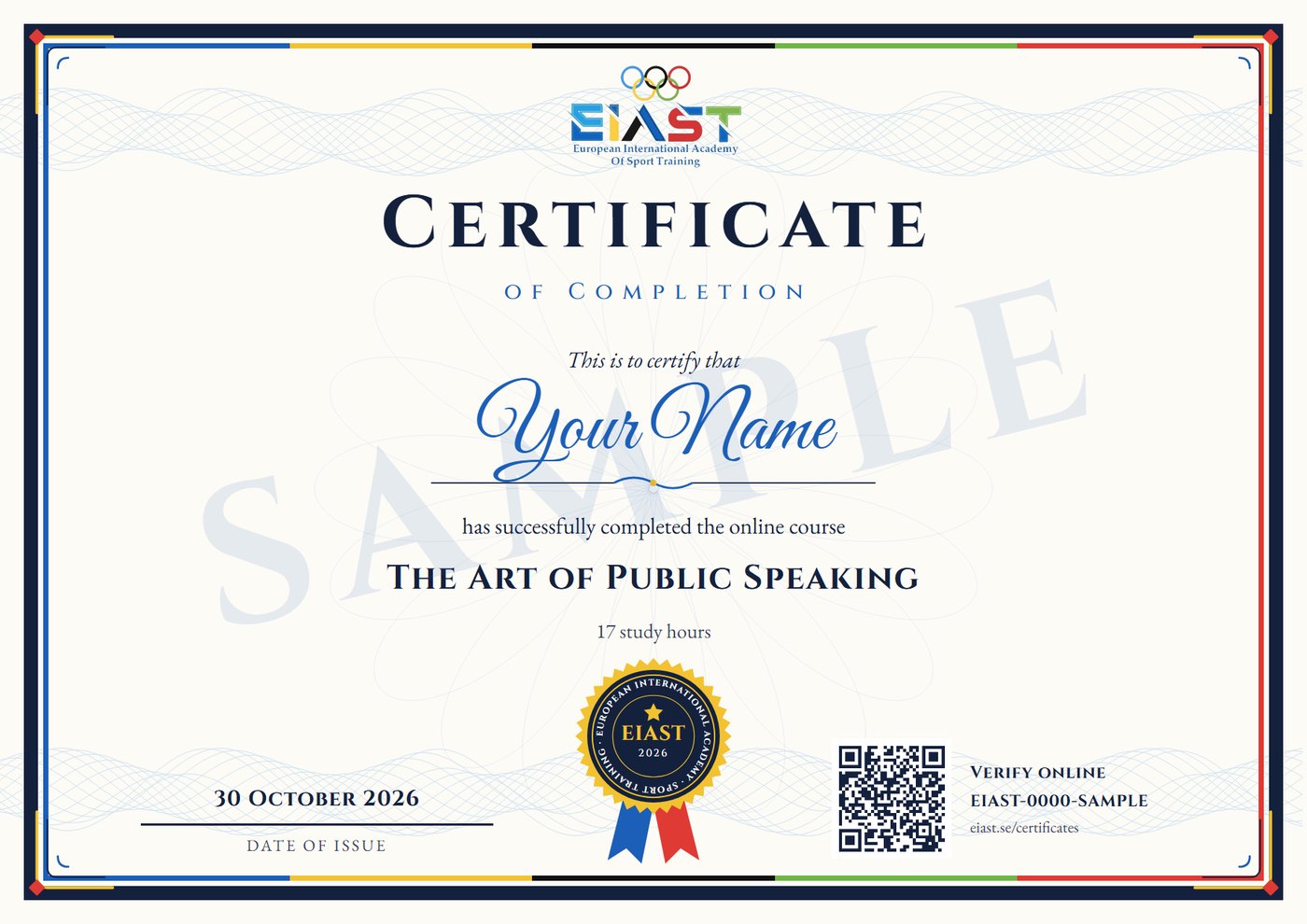 View the sample at full size
Start the course today
Buy the course once and unit one opens. Each unit opens the next, then the graduation project and the final exam, and your certificate is issued as soon as you pass.