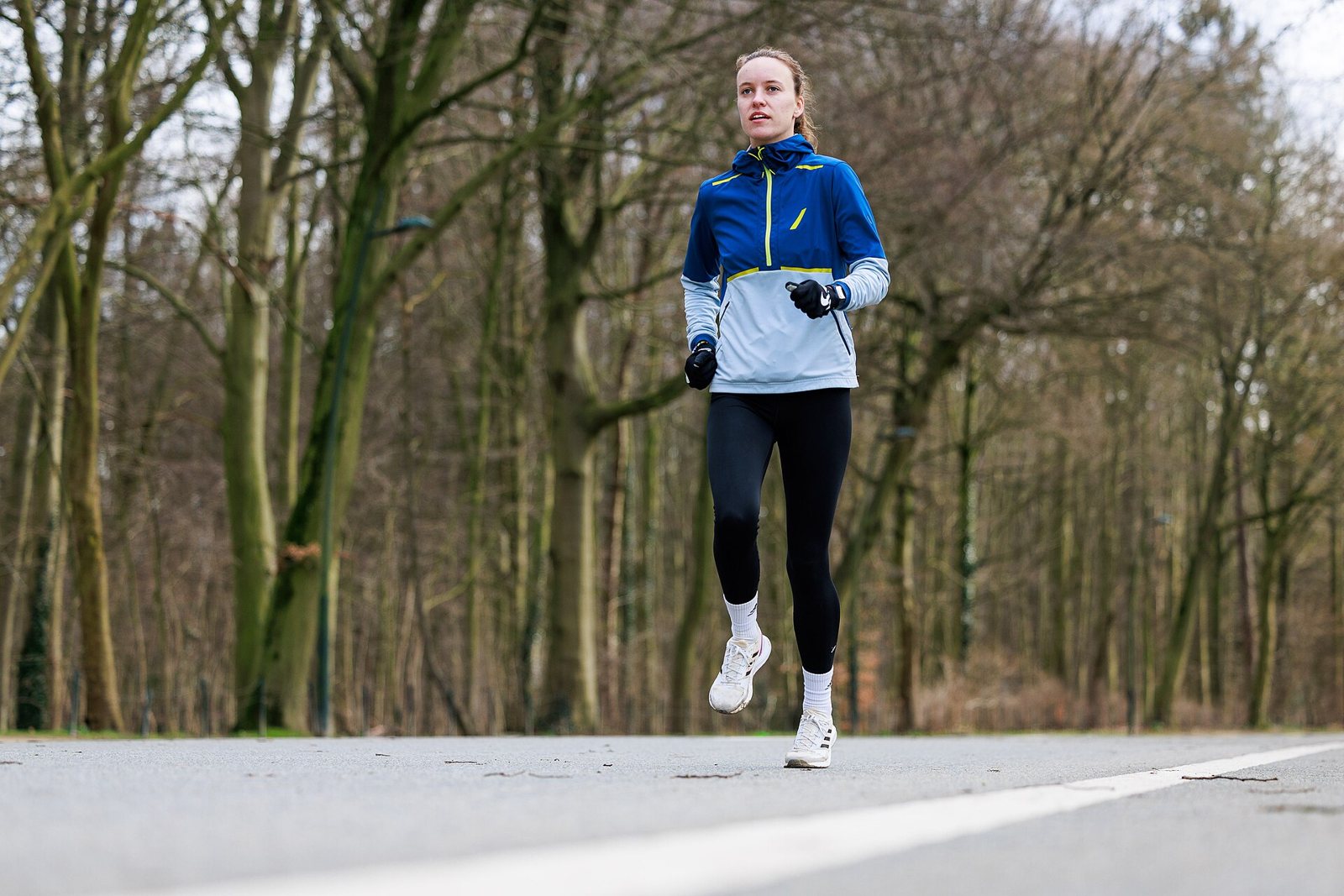
Training with Your Smartwatch
and Wearables
Your watch measures your heart rate, your sleep and your steps, and gives you numbers and advice every morning. This course teaches you what those numbers mean: what happens in your body during training, how the watch measures and how accurate it can be, how to plan a programme with correct zones and analyse your data, how numbers affect your motivation and behaviour, and how to judge with a critical mind what you read about training and health. Then you apply all of it to yourself in a programme documented with your watch.
This course is taught in Arabic: the videos, the texts and the quizzes are in Arabic.
14 units in 4 modules20 hours (approx.)180 quiz questions$69 · 259 SAR PriceCertificate with a verification number
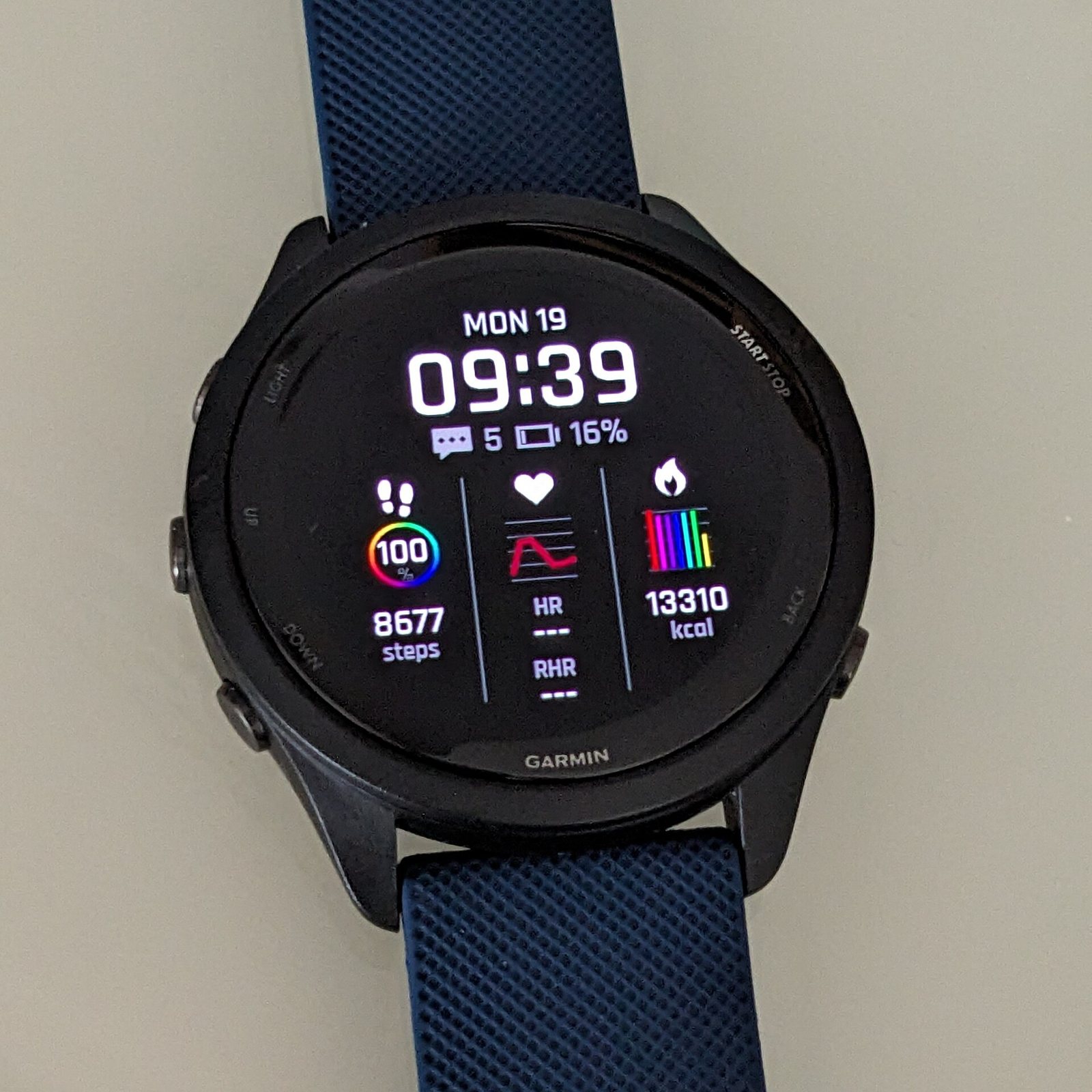
The four modules and the fourteen units
Every unit has a video, the full text with tables, diagrams and pictures, a practical tool you apply to your watch, a case study to discuss, a worksheet and a ten-question quiz. Throughout the course we follow Nour, who has just bought her first watch; Faisal, who chases ten thousand steps; Youssef, a university team player; and Karim, a personal trainer.
Module 1: The body and training science
- 57 min · free
Smartwatches and training: numbers in the service of the body
Why watches and wearables have spread, what they measure and what they don’t, the course’s three pillars — the science of the body, measurement, and people and numbers — and setting up your watch before you start.
- 72 min
Exercise physiology: energy, the heart, breathing and the muscles
The three energy systems, the heart, circulation and stroke volume, breathing and oxygen uptake, muscle fibres, and what happens in the body in the first minute and the first hour of exercise.
- 67 min
Adapting to training: load, recovery and principles
Supercompensation, the six training principles, recovery and sleep, overtraining, heart and muscle adaptations over time, and how they show up in your watch’s numbers.
- 67 min
Training intensity: heart rate, thresholds and perceived exertion
Maximum heart rate, its formulas and their limits, heart-rate reserve, the aerobic and anaerobic thresholds, intensity zones, the polarised model, the perceived exertion scale and the talk test.
Module 2: The watch, measurement and reliability
- 62 min
How the watch measures: sensors and algorithms
The optical sensor on the wrist, the accelerometer and gyroscope, GPS, the barometer, ECG on some watches, and from the raw signal to the number on the screen.
- 62 min
Heart rate at rest and in exercise: accuracy and sources of error
Resting heart rate and what it means, wrist heart-rate accuracy compared with a chest strap, and sources of error — movement, skin tone, tattoos, cold and how the watch is worn — and when to trust the number and when not to.
- 67 min
Heart-rate variability: recovery, stress and readiness
What heart-rate variability and the autonomic nervous system are, how it is measured, your personal baseline, what raises and lowers it, using it to guide training, and its limits and common misreadings.
- 72 min
Sleep, calories, steps and fitness estimates: how reliable they are
Sleep tracking and sleep stages, estimating calories burned, steps and distance, estimating VO2max, readiness scores, and what studies say about the accuracy of each.
- 72 min
Training load and data analysis: from the number to the decision
Internal and external load, load from perceived exertion and session length, the acute-to-chronic load ratio and its limits, trends and moving averages, signal and noise, and exporting your data and analysing it in a spreadsheet.
Module 3: People and numbers
- 67 min
Motivation and behaviour change: why we exercise and why we stop
Self-determination theory, intrinsic and extrinsic motivation, habits and cues, the capability-opportunity-motivation model, goals, stages, and how the watch can help or get in the way.
- 62 min
People and numbers: when they help us and when they harm us
The quantified-self movement, gamification, badges and streaks, when a number becomes a goal in itself, anxiety about sleep and measuring, losing touch with your body, and how to put numbers in their place.
- 57 min
Training on social media, and privacy
Showing training on sports apps and social media, comparison and pressure, the ideal image of body and performance, the privacy of health and location data, and security settings.
Module 4: Critical thinking and application
- 67 min
Critical thinking about training and health information
Where information comes from, types of evidence and the evidence pyramid, correlation and causation, relative and absolute numbers, influencers and ads, claims about devices and supplements, and questions to ask before you believe.
- 72 min
Your programme documented with your watch, and the graduation project
Planning a six- to eight-week programme, measuring before and after, daily documentation, analysis and charts, discussing reliability and behaviour, and critical reflection, then an explanation of the graduation project.
- 4 hours (approx.)
Graduation project
“A personal training report with your smartwatch”: a six- to eight-week programme you carry out and document with your watch, then analyse and critique in eight parts: profile and goal, baseline, the programme, documentation, analysis, reliability, behaviour and numbers, and critical reflection. Assessed by the smart tutor; the pass mark is 60.
- 60 min
Final exam
Forty questions from the four modules. Get twenty-eight right and your certificate is issued.
Who this course is for
- Amateur athletes in running, cycling and fitness who own a watch or a band.
- Personal trainers and fitness coaches who use their clients’ data.
- Physical education teachers and anyone interested in digital health.
- Anyone who wants to understand their watch’s numbers and use them wisely rather than anxiously.
What you get
- 14 videos that explain each unit with pictures and diagrams.
- Ready-made tools: a zones calculator, a heart-rate comparison log, HRV tracking, a table of how reliable each measure is, a weekly data dashboard, a habit-change plan, and a health information checklist.
- A personal programme project documented with your watch, assessed by the smart tutor.
- A smart tutor that answers from the unit’s text.
- A certificate of completion with a verification number. All you need is a smartwatch or band of any kind that measures heart rate.
Your certificate when you pass
Pass the graduation project and the final exam, and your certificate is issued at once in your name, ready to print or save as a PDF.
- A certificate of completion in English in A4 size.
- A verification number of its own, and a QR code that opens the verification page on eiast.se.
- Your study hours, your graduation project mark and your final exam result.
- It stays valid and any organisation can verify it at any time. It is a certificate of completion from the academy.
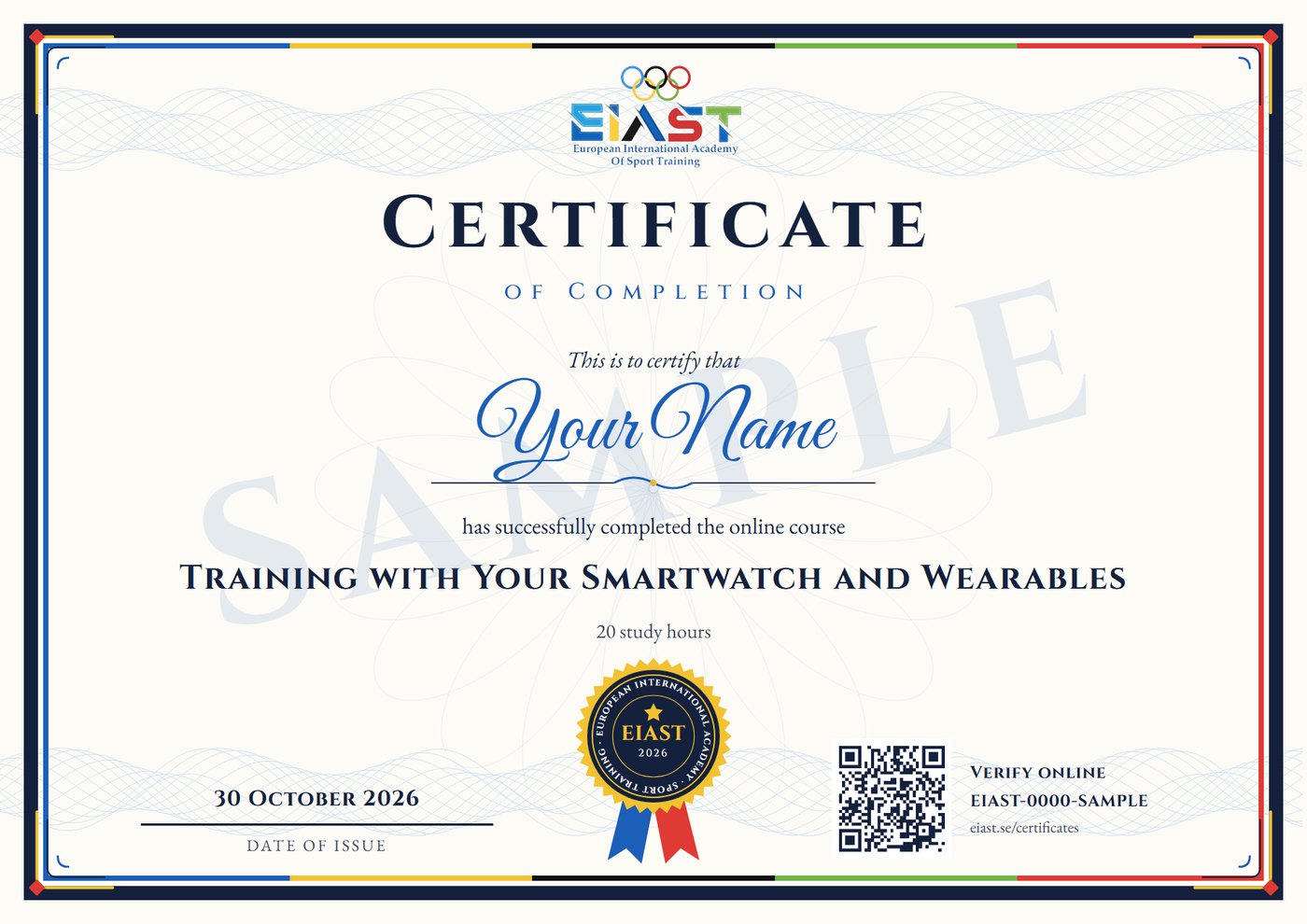 View the sample at full size
Start the course today
Buy the course once and unit one opens. Each unit opens the next, then the graduation project and the final exam, and your certificate is issued as soon as you pass.