Neck, Back and Shoulder Injuries for Coaches: From Prevention to Safe Return to Training
For every coach facing a trainee who says ’my back hurts’, ’I have a disc’ or ’my shoulder popped out’: understand the spine and shoulder and what happens in the disc and nerves, recognise the red flags that cannot wait, modify exercises and build a safe, graded programme after medical clearance, and bring the athlete back to competition by criteria, without diagnosing or treating.
This course is taught in Arabic: the videos, the texts and the quizzes are in Arabic.
10 units16 hours (approx.)140 quiz questions$69 · 259 SAR PriceCertificate with a verification number
The ten units
Every unit has the full text with tables, diagrams and pictures, a practical tool for your gym or team, a case study for discussion, a worksheet, a ten-question quiz, and a video in which Mazen explains the unit with pictures and diagrams. We follow coaches in real situations: Samer and his MRI report, Rana and three evening messages, Mustafa and the morning lift, a handball team with three sore shoulders, and Ali before the final.
Module 1: Foundations and safety
- 60 min · free
The spine and shoulder: the anatomy a coach needs, understanding pain, and the limits of the coach’s role
The vertebrae, discs and nerves and the four regions of the spine, the shoulder joint, shoulder blade and rotator cuff, why pain does not equal damage, why ’slipped discs’ show up on scans of people without pain, and what a coach does and never does: no diagnosis and no treatment, but observation, referral and safe exercise after medical clearance.
- 65 min
Danger signs: when to stop training and send the trainee to a doctor at once
Danger signs in the neck, back and shoulder by the international framework: cauda equina syndrome, fracture, tumour, infection, the spinal cord, the neck arteries, shoulder pain coming from the heart, neck injury on the pitch, and the three-colour traffic light: ambulance now, a doctor today or tomorrow, or modified exercise with follow-up; and how to talk to the trainee and keep a record.
Module 2: The neck, the back and the disc
- 60 min
Neck pain and the cervical disc: causes and types
The four types of neck pain in the JOSPT guideline, phones, screens, sleep and stress, neck pain spreading into the arm and what it means, bulge, protrusion and herniation of the cervical disc, whiplash, ’stingers’ in contact sports, and what usually happens over time.
- 60 min
Safe exercise for the neck and the return to training
What the guideline says about exercise for neck pain, the deep neck muscles and the shoulder blade, isometric and graded exercises, the exercises to stop or modify: behind-the-neck presses, neck bridges, headstands and loads on the neck, tackling technique and heading the ball, and the stages of return after medical clearance.
- 65 min
Low back pain: types, causes and myths
Non-specific and specific back pain and nerve-root pain, what the Lancet series, NICE and the WHO say, physical, psychological and social risk factors, yellow flags, the myths of bed rest, scans and the ’slipped’ vertebra, and spondylolysis in young athletes.
- 65 min
The lumbar disc and sciatica: what the coach needs to know
How the lumbar disc is built and the stages of herniation, sciatica, numbness and weakness, why many herniations shrink on their own, the doctor’s path from conservative care to surgery, the signs that turn the case into an emergency, and the coach’s role: staying active, walking, modifying training and the pain-monitoring rule.
- 75 min
Safe exercise for the back: from movement to full load
Exercise as the best-proven treatment for back pain, the pain-monitoring rule in numbers, McGill’s big three and trunk exercises, the hip hinge and the Romanian deadlift, the truth about bending the back when lifting, the exercises to modify in the painful phase: heavy lifts, jumping and axial loading, and the progression back to squats, deadlifts and running.
Module 3: The shoulder, prevention and return
- 70 min
The shoulder: rotator cuff pain, dislocation and instability
Rotator cuff related pain and what used to be called impingement, a cuff tear after a fall, frozen shoulder, shoulder dislocation and instability with and without injury, the acromioclavicular joint, the labrum in throwers, scapular dyskinesis, and the red flags of the shoulder.
- 70 min
Safe shoulder exercise for throwers and overhead athletes
Progressive strengthening of the rotator cuff and shoulder blade, the Norwegian shoulder injury prevention programme (OSTRC) that cut shoulder problems in handball, the exercises to avoid or modify: pulldowns and presses behind the neck, deep dips, narrow-grip upright rows and kipping pull-ups, managing throwing load, and the return stages after a dislocation by the Bern consensus.
- 75 min
Prevention, posture and the return to competition, and the graduation project
The truth about posture and sitting up straight, the prevention that works and the prevention that does not: exercise with education, not belts or insoles, managing load and sleep, the return continuum: to participation, then to sport, then to performance, working with the doctor and physiotherapist, and the graduation project explained part by part.
- 4 hours
Graduation project
“The safe-return file": a coach’s plan for a real athlete coming back from neck, back or shoulder pain after medical clearance, in seven parts: the case as the doctor described it, red flags and the referral plan, what is off-limits and the alternatives, the graded programme in numbers, return criteria, prevention, and communication.
- 60 min
Final exam
Forty questions from the three modules, ten of them on two case studies. Pass with twenty-eight and your certificate is issued.
Built on international evidence, sized to the coach’s role
The content comes from published clinical practice guidelines and international consensus statements: the NICE guideline on low back pain and sciatica, the JOSPT guidelines on neck pain and low back pain, the 2023 WHO guideline, the Lancet series, the international red flags framework, the Bern shoulder consensus and the OSTRC shoulder trial, with references at the end of every unit.
What the coach does
Observes, asks and records, refers at once on a red flag, modifies the exercise, builds strength and endurance gradually after clearance, reassures the trainee and keeps in touch with the doctor and physiotherapist.
What the coach does not do
Does not diagnose or read scans, does not ’crack’ a back or put a dislocated shoulder back, does not prescribe medicines or injections, and does not decide the return to competition alone. The course does not replace a doctor or physiotherapist.
Who this course is for
- Fitness coaches and personal trainers who meet trainees with back, neck and shoulder complaints every day.
- Team coaches and strength and conditioning coaches in handball, volleyball, swimming, rugby, wrestling and football.
- Physical education teachers.
- Anyone who trains older adults or office workers.
What you get
- 10 videos presented by Mazen, explaining each unit with pictures and diagrams, plus the full text of every unit.
- Ready-made tools: the coach’s role card, the referral traffic-light card, a neck observation log, a 4-stage neck programme, a yellow-flag card, a daily symptom diary, the ladder back to back exercises, a shoulder injury map, a preventive shoulder programme and the safe-return file.
- A safe-return file for a real athlete, graded by the AI tutor.
- A smart tutor that answers from the unit’s text.
- A certificate of completion with a verification number.
Your certificate when you pass
Pass the graduation project and the final exam, and your certificate is issued at once in your name, ready to print or save as a PDF.
- A certificate of completion in English in A4 size.
- A verification number of its own, and a QR code that opens the verification page on eiast.se.
- Your study hours, your graduation project mark and your final exam result.
- It stays valid and anyone can verify it at any time. It is a certificate of completion from the academy, not a university degree and not a licence to practise physiotherapy or medicine.
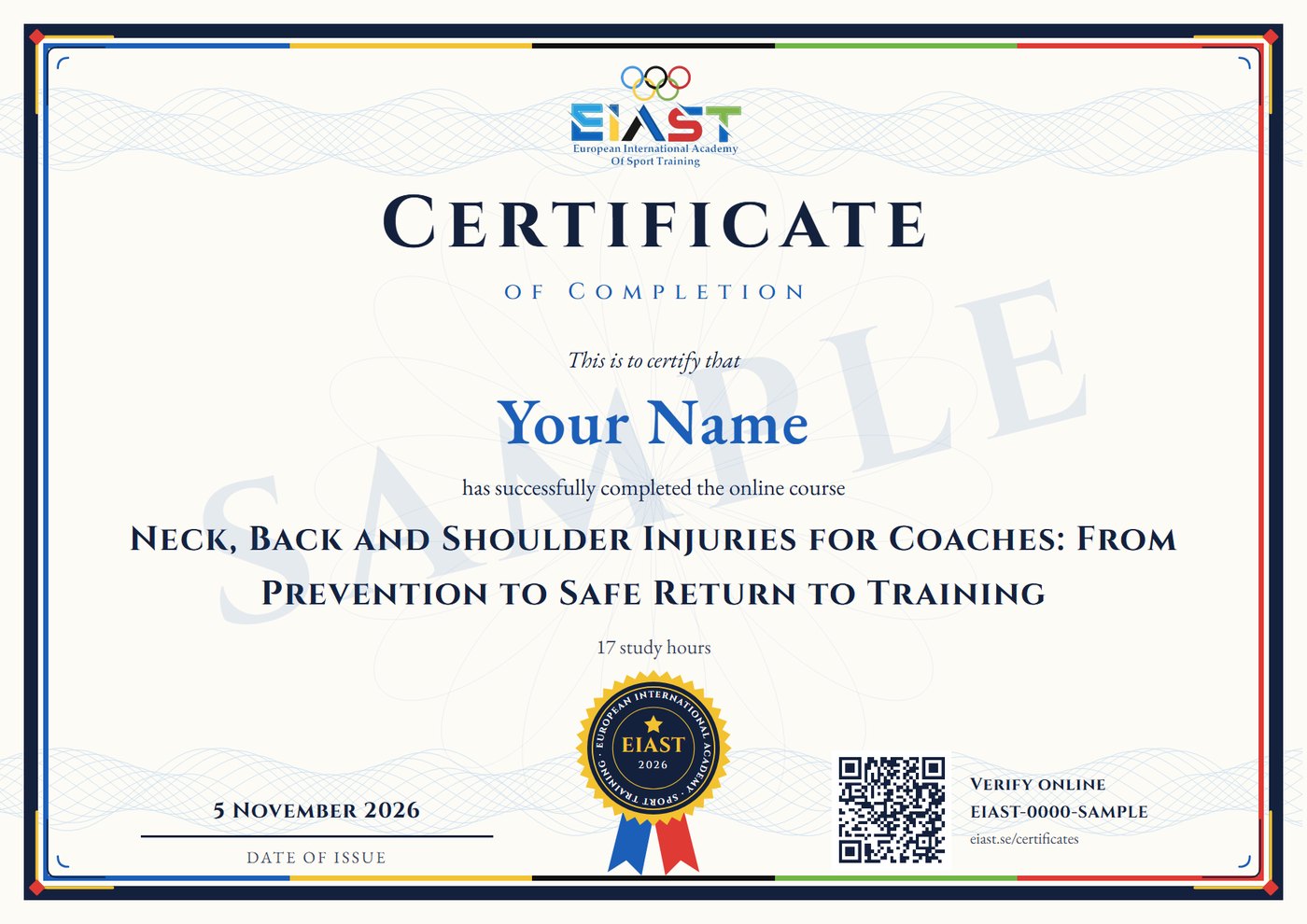 View the sample at full size
Start the course today
Buy the course once and unit one opens. Each unit opens the next, then the graduation project and the final exam, and your certificate is issued as soon as you pass.
Please note: This is an educational course for coaches. It does not teach diagnosis or treatment and does not replace a doctor or physiotherapist. Any new or lasting pain, or pain with a red flag, needs a medical assessment.
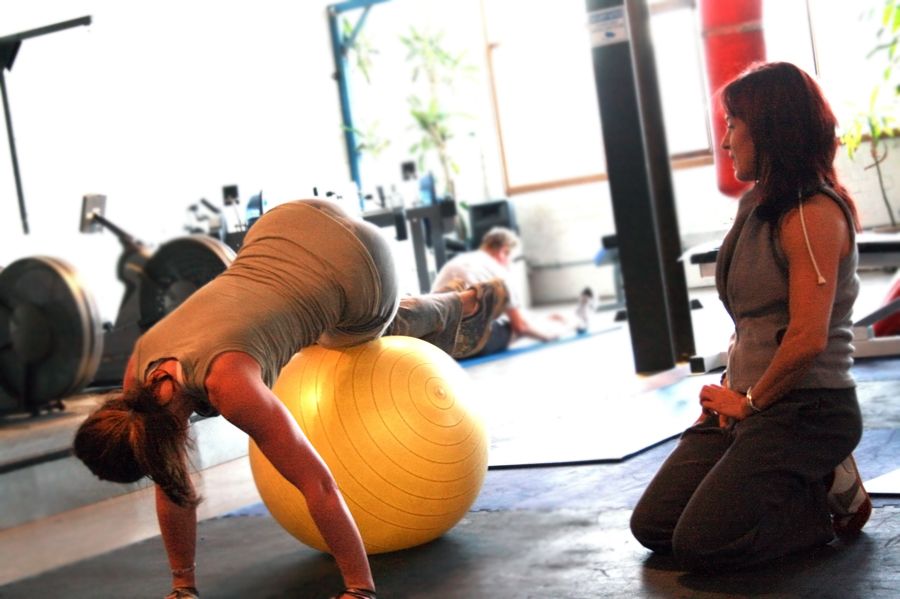
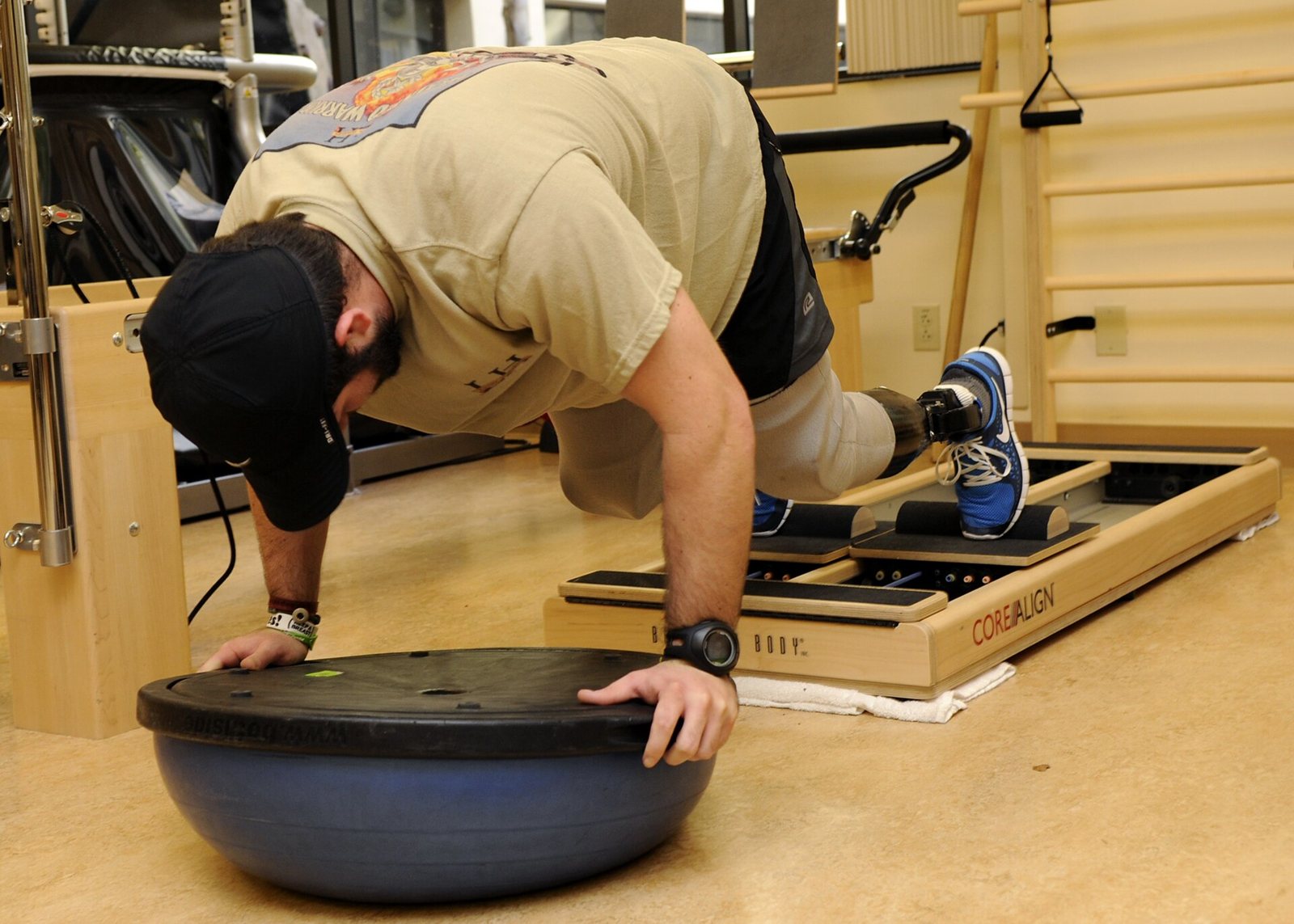
Image credits: Physical therapy session: U.S. Navy, public domain · Personal trainer and client: www.localfitness.com.au, CC BY-SA 3.0. Via Wikimedia Commons.