Foundation Diploma in Sports Commentary
From zero to your first voice portfolio: you train your voice and your language, describe the moment and read the system, prepare the commentator’s board, work in television, radio and on digital platforms, and commentate with your own voice in the commentator’s studio on clips from a cup final, while it measures your pace, your pauses and your vocal energy and the smart tutor gives you feedback.
This course is taught in Arabic: the videos, the texts and the quizzes are in Arabic.
16 units in 4 modules23 hours (approx.)200 quiz questions$149 · 559 SAR PriceCertificate with a verification number
The four modules and the sixteen units
Every unit has a video, the full text with pictures and diagrams, a ready-to-use practical tool, a voice exercise you record on your phone, a case study to discuss, a worksheet and a ten-question quiz. Throughout the diploma we follow Samer, a beginner commentator preparing for the first final he will call: Al-Rafidain against Dijla.
Module 1: The foundations of the profession, the voice and the language
- 62 min · free
Sports commentary: the profession and the commentator’s role
What sports commentary is and its types, the difference between the play-by-play commentator and the analyst, what the profession demands in voice, language, knowledge and personality, and the beginner’s path from training to the first match.
- 77 min
The voice is the commentator’s tool: breathing, pronunciation and vocal health
Breathing from the diaphragm, articulation and clear pronunciation, warming up the voice before going on air, and protecting the throat from strain in long matches.
- 76 min
Delivery and vocal performance: rhythm, pitch and colour
Speaking rate, pitch and loudness, pauses and tone, and how to build the vocal climb from the attack to the goal call without losing your voice.
- 72 min
The commentator’s language: simplified standard Arabic, vocabulary and common mistakes
Simplified standard Arabic and the limits of dialect, a bank of vocabulary and lively verbs, common grammar mistakes on air, pronouncing foreign players’ names, and escaping worn-out phrases.
Module 2: The arts of match commentary
- 76 min
Live description and quick thinking
The who-what-where rule, the present tense, economy of words, anticipating the next move, and daily exercises to speed up your thinking and link the eye to the tongue.
- 72 min
Managing your voice and emotions during the match
Spreading your energy across ninety minutes, the moment of the goal, deliberate silence, neutrality when your own national team plays, and dealing with anger, controversy and refereeing errors on air.
- 71 min
Reading systems and styles of play while commentating
How to recognise both teams’ systems in the first minutes, the five phases of play, styles of pressing, build-up and counter-attack, and naming what you see in language the viewer understands.
- 67 min
Tactical analysis for commentators: when and how to analyse
The difference between description and analysis, when to analyse (the replay, a stoppage, half-time), the observation-cause-effect template, and working with the analyst and the co-commentator.
Module 3: Preparation and working in radio and television
- 82 min
Preparing the match file: information and statistics
Sources of information and checking them, the commentator’s board with players, numbers and stories, turning a statistic into a story, and an emergency kit for silent minutes.
- 76 min
Television commentary: working with the picture, the cameras and the director
Let the picture speak, camera angles, replays and graphics, the director’s earpiece and communicating with the control room, and commentating from the studio off a screen.
- 72 min
Radio commentary: painting the match with words
The listener sees nothing: directions on the pitch, repeating the score and the time, describing the place and the atmosphere, the rhythm of radio, and the practical differences between the radio and the television microphone.
- 72 min
Live commentary, recorded commentary and digital content
The difference between live broadcast and recorded commentary, commentating on highlights, podcasts and short videos, and recording at home with simple tools.
Module 4: Professionalism and the future
- 72 min
Commentating on tournaments and big matches
Preparing for a whole tournament, the opening match and the final, national teams, commentating on penalty shoot-outs, celebrations and historic moments, and managing fatigue in long tournaments.
- 62 min
Professional ethics and dealing with mistakes
Neutrality and fairness, respectful language and preventing racism and abuse, defamation and legal responsibility, correcting a mistake on air, and commentating on VAR decisions, ads and sponsors.
- 67 min
Technology and smart tools in commentary
Tracking data and live statistics, smart tools for preparation, research and voice training, remote commentary, and synthetic voices: what they threaten and what they cannot do.
- 77 min
The voice portfolio and building a career
How to build a voice portfolio that opens doors, channel auditions, your personal brand and social media, freelance work and contracts, and a development plan for your first year, then the graduation project.
- 3 hours (approx.)
Graduation project
“The commentator’s portfolio”: eleven parts, from the commentator’s board, the opening and the clip scripts to the radio version, a real recording of your voice from the studio, your charter and your career plan, assessed by the smart tutor. The pass mark is 60.
- 60 min
Final exam
Forty questions, ten of them on two practical commentary cases. Get twenty-eight right and your certificate is issued.
The commentator’s studio: practise with your own voice
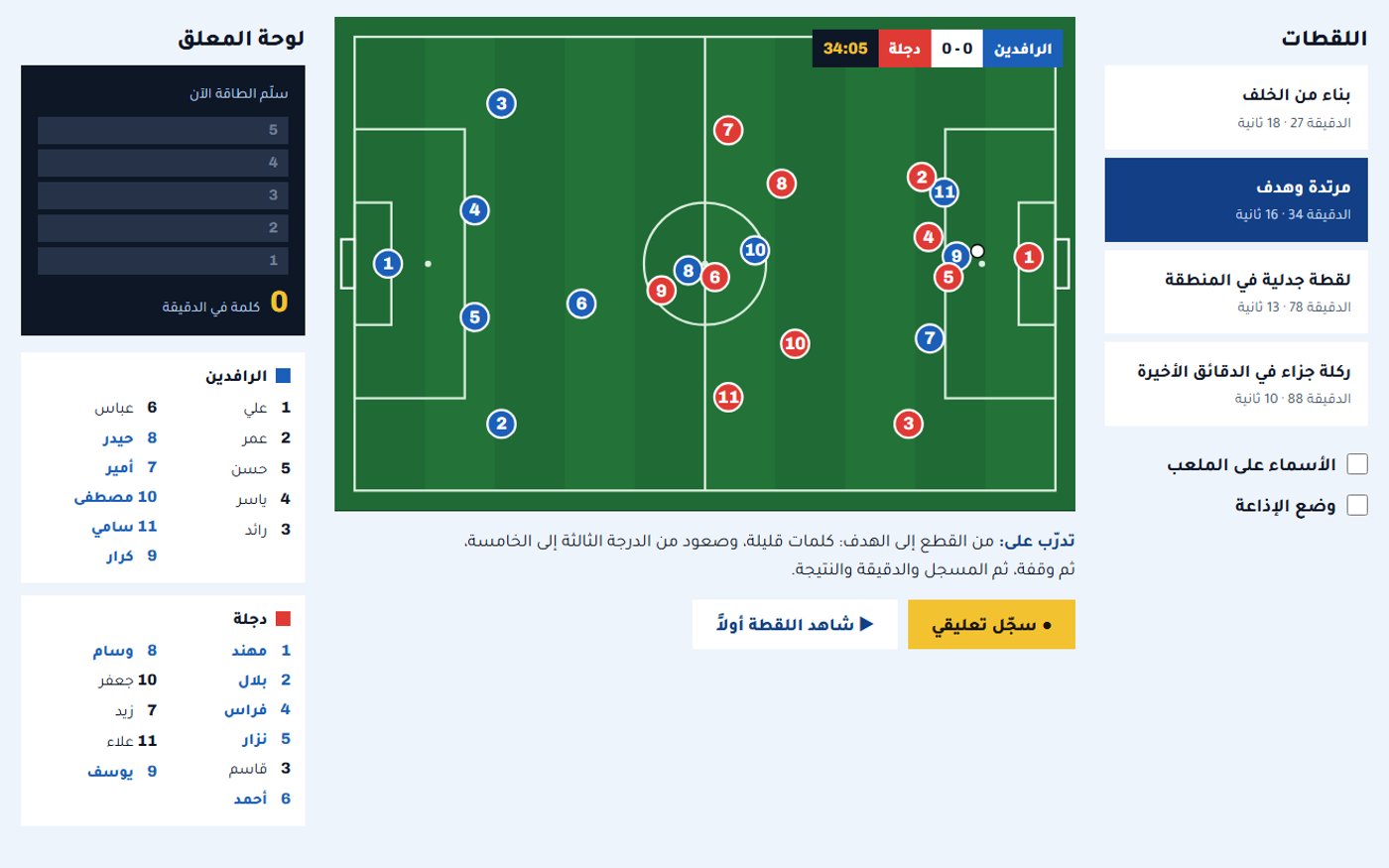
You cannot learn commentary by reading alone. In the studio you watch a moving clip from the final on a screen as if it were a real broadcast, commentate on it with your own voice, then see the result at once.
- Four clips: a build-up from the back, a counter-attack and goal, a controversial incident with a VAR review, and a penalty in the final minutes.
- The energy ladder, live: you see your voice level from 1 to 5 as you speak, then your voice curve across the clip.
- Real measurements: words per minute, pauses, the names you mentioned, and checks on the moment of the goal and the VAR decision.
- The smart tutor: specific feedback, a model version of the same clip with performance cues, and radio mode.
Who this diploma is for
- Anyone who dreams of working as a sports commentator and is starting from zero.
- Sports journalists and presenters who want to move into commentary.
- Former players and coaches heading to the microphone as analysts or commentators.
- Sports content creators on digital platforms and podcasts.
What you get
- 16 videos that explain each unit with examples and diagrams, including models of the vocal climb and the moment of the goal.
- The commentator’s studio for practising with your own voice, with live measurements and feedback from the smart tutor.
- Ready-made tools: a voice warm-up routine, the energy ladder, a vocabulary bank, the commentator’s board, the radio rule, the commentator’s charter and the structure of a voice portfolio.
- A smart tutor that corrects your scripts and your language and suggests exercises.
- A certificate of completion with a verification number issued when you pass the project and the final exam.
Your certificate when you pass
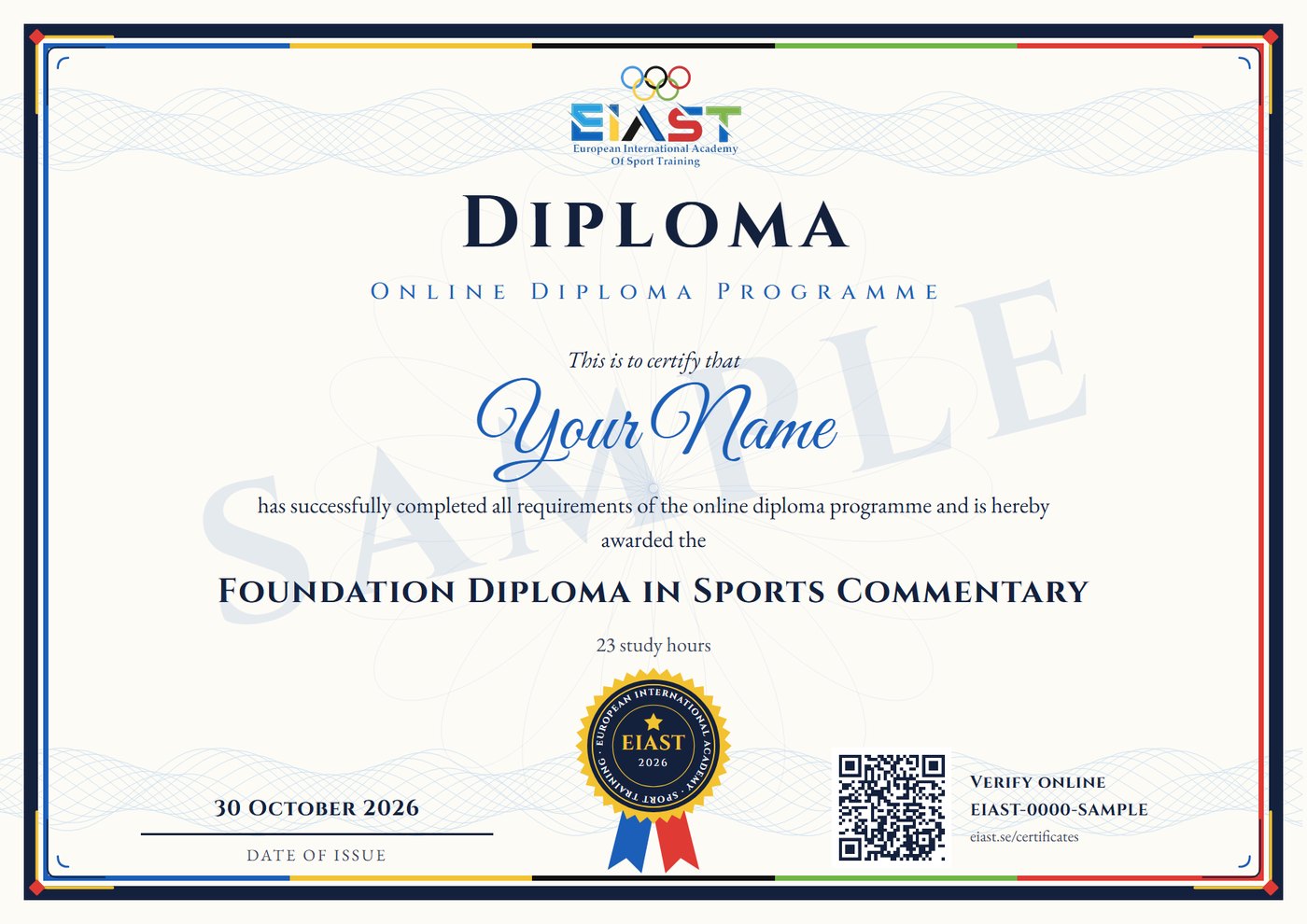
Pass the graduation project and the final exam, and your certificate is issued at once in your name, ready to print or save as a PDF.
- A certificate of completion in English in A4 size.
- A verification number of its own, and a QR code that opens the verification page on eiast.se.
- Your study hours, your graduation project mark and your final exam result.
- It stays valid and any organisation can verify it at any time. It is a certificate of completion from the academy, not a university degree or a licence from a media body.
 View the sample at full size
Start the course today
Buy the course once and unit one opens, and you practise in the studio with your own voice. Each unit opens the next, then the graduation project and the final exam, and your certificate is issued as soon as you pass.