Youth Football Coaching
and Academy Development
A course for everyone who coaches children and young players or runs an academy: you understand the child at every age, lead the group through encouragement, teach skills with small-sided games and a ball for every player, teach understanding of the game and goalkeeping, lead match day with fair playing time, work with parents, write the academy curriculum and the season plan, and keep children safe.
This course is taught in Arabic: the videos, the texts and the quizzes are in Arabic.
14 units in 4 modules22 hours (approx.)180 quiz questions$69 · 259 SAR PriceCertificate with a verification number
The four modules and the fourteen units
Every unit has a video, the full text with tables, diagrams and pictures, a ready-to-use practical tool, a case study to discuss, a worksheet and a ten-question quiz. Throughout the course we follow Karim, a coach at Al-Amal Academy, with his under-9 team: Youssef, born in December; Sara, in the girls’ team; and Ali, in his growth spurt.
Module 1: The child and the coach
- 61 min · free
Football for children and young players: philosophy, values and the coach’s role
Why children play football, “play first”, the most players for the longest time, a ball for every player, everyone plays, the coach’s tasks, and the difference between children’s and adults’ football.
- 77 min
The development of children and young players: body, movement, mind and feelings
Physical, motor, mental, emotional and social development from 5 to 16, the growth spurt, biological age, the relative age effect, and sampling many sports before specialising.
- 72 min
Leading children: communication, gathering the group, motivation and group management
How to talk to children and gather them, praise and correction, intrinsic motivation and a development climate, rules, dealing with difficult behaviour, and the coach as a role model.
- 67 min
Safeguarding and safety at the academy
Children’s rights in sport, forms of abuse and their signs, the coach’s professional conduct, digital communication, reporting, and safety on the pitch, in the heat and in first aid.
Module 2: Teaching, the session and understanding the game
- 77 min
Teaching skills: how children learn movement and technique
The stages of learning a skill, showing before explaining, progressing from no opponent to play, learning from situations, feedback, the key skills for each age, and both feet.
- 77 min
The training session: structure, organisation and small-sided games
What, why and how, building the session from the welcome to the finish, a ball for every player and no queues, small groups, small-sided games, and organising space and time.
- 72 min
Understanding the game (1): attacking and defending for young children
The player on the ball facing forward and facing away, being available and distance, 1 v 1 and 2 v 1, simple defending principles, and a shared football language with children aged 6 to 11.
- 77 min
Understanding the game (2): team play for young players aged 11 to 16
Attacking principles (width, depth, availability and distance), defending principles (pressure, cover and support), transition, teaching through small-sided situations, and positions without early specialisation.
Module 3: Fitness, goalkeeping and the match
- 77 min
Fitness for children and young players: coordination, speed, strength and endurance
Coordination and agility, speed, safe strength for young players, endurance through play, intensity by colours, the warm-up and prevention, and taking account of the growth spurt.
- 61 min
Goalkeeping for children and young players
Everyone tries goalkeeping, safe catching, the ready position, falling, positioning, distribution, coaching goalkeepers aged 9 to 12, and supporting the goalkeeper mentally.
- 67 min
The match: formats by age, the rules and leading on match day
From 3 v 3 to 11 v 11, the pitch, ball and goal for each age, the key rules of youth football, fair playing time, and leading before, during and after the match.
Module 4: Parents and the academy
- 62 min
Parents and the club: communication, healthy competition and selection
The role of parents and how to involve them, the start-of-season meeting, handling pressure and disagreement, healthy competition, selection and talent and its risks, and the club’s role in protecting children.
- 82 min
The academy curriculum: the six stages from 3 to 15 years and the season plan
Dividing the player’s journey into six stages, the technical, tactical, physical, psychological and social aims of each stage, a 36-week season plan, and assessment and levels of progress.
- 72 min
Young players’ health, running the academy, and the graduation project
Nutrition, water, sleep and Ramadan, growth injuries and concussion, organising the academy, its coaches and quality, then an explanation of the graduation project.
- 4 hours (approx.)
Graduation project
“A season plan for an age group at an academy”: ages 6–7, 8–9, 10–11 or 12–13, in eight parts, from understanding the child and the aims to the season plan, three complete sessions, match day, parents and safeguarding. Assessed by the smart tutor; the pass mark is 60.
- 60 min
Final exam
Forty questions from the four modules. Get twenty-eight right and your certificate is issued.
Who this course is for
- Coaches of children and young players at clubs, academies and football schools.
- Academy directors and technical coordinators who write the curriculum.
- Physical education teachers, and parents who volunteer to coach their children’s teams.
- Former players who want the right start in coaching children.
What you get
- 14 videos that explain each unit with pictures and diagrams.
- Ready-made tools: the session plan, the young goalkeeper programme, the match-day plan, the parents’ charter and a 36-week season plan.
- Diagrams of drills and situations, and the health and safety checklist.
- A smart tutor that answers from the unit’s text.
- A certificate of completion with a verification number issued when you pass the project and the final exam.
Your certificate when you pass
Pass the graduation project and the final exam, and your certificate is issued at once in your name, ready to print or save as a PDF.
- A certificate of completion in English in A4 size.
- A verification number of its own, and a QR code that opens the verification page on eiast.se.
- Your study hours, your graduation project mark and your final exam result.
- It stays valid and any organisation can verify it at any time. It is a certificate of completion from the academy, not a substitute for official coaching licences from football associations.
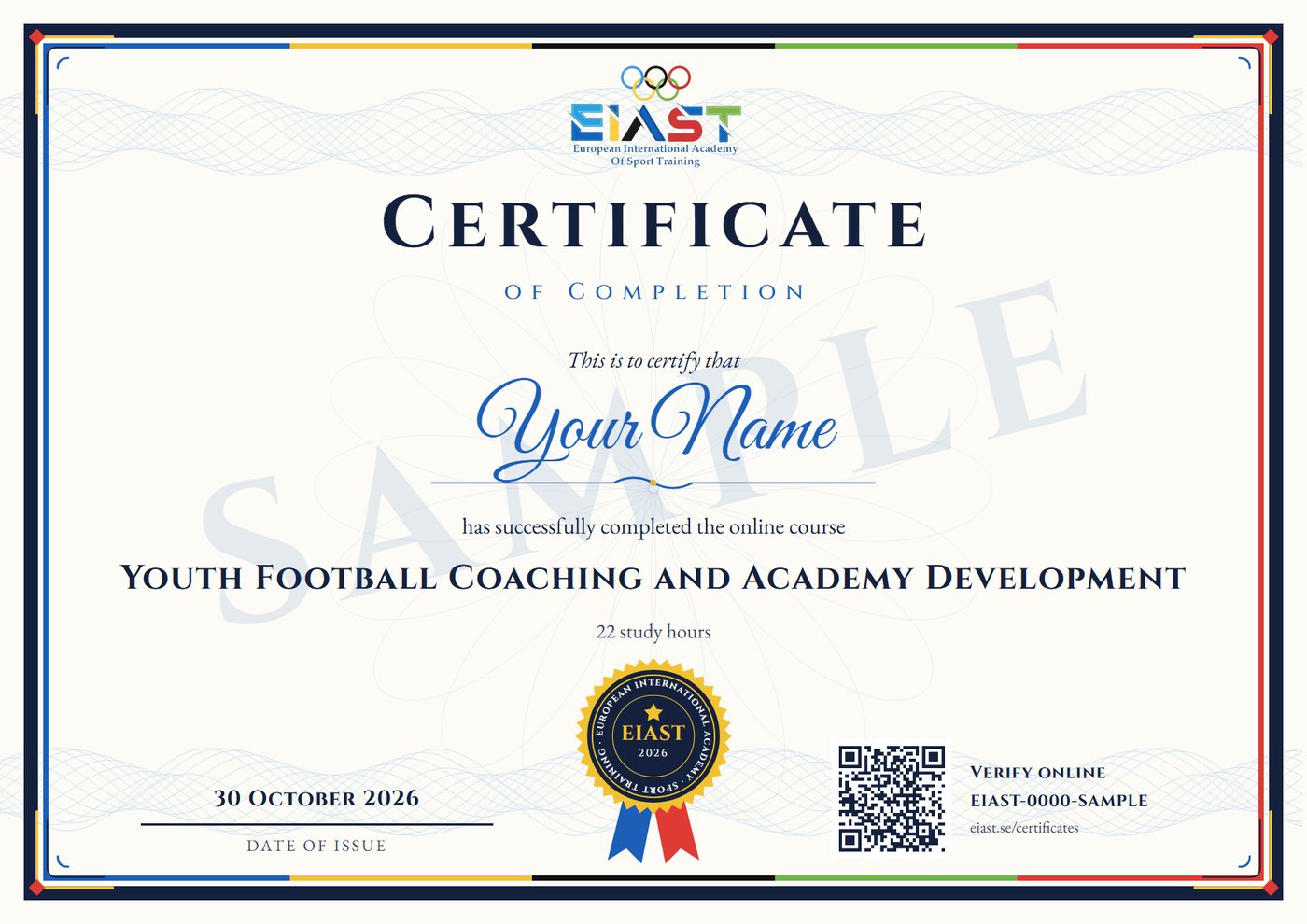 View the sample at full size
Start the course today
Buy the course once and unit one opens. Each unit opens the next, then the graduation project and the final exam, and your certificate is issued as soon as you pass.